Best Available Techniques define how industrial wastewater must be treated in Europe. We help you understand your requirements and design treatment that meets them.
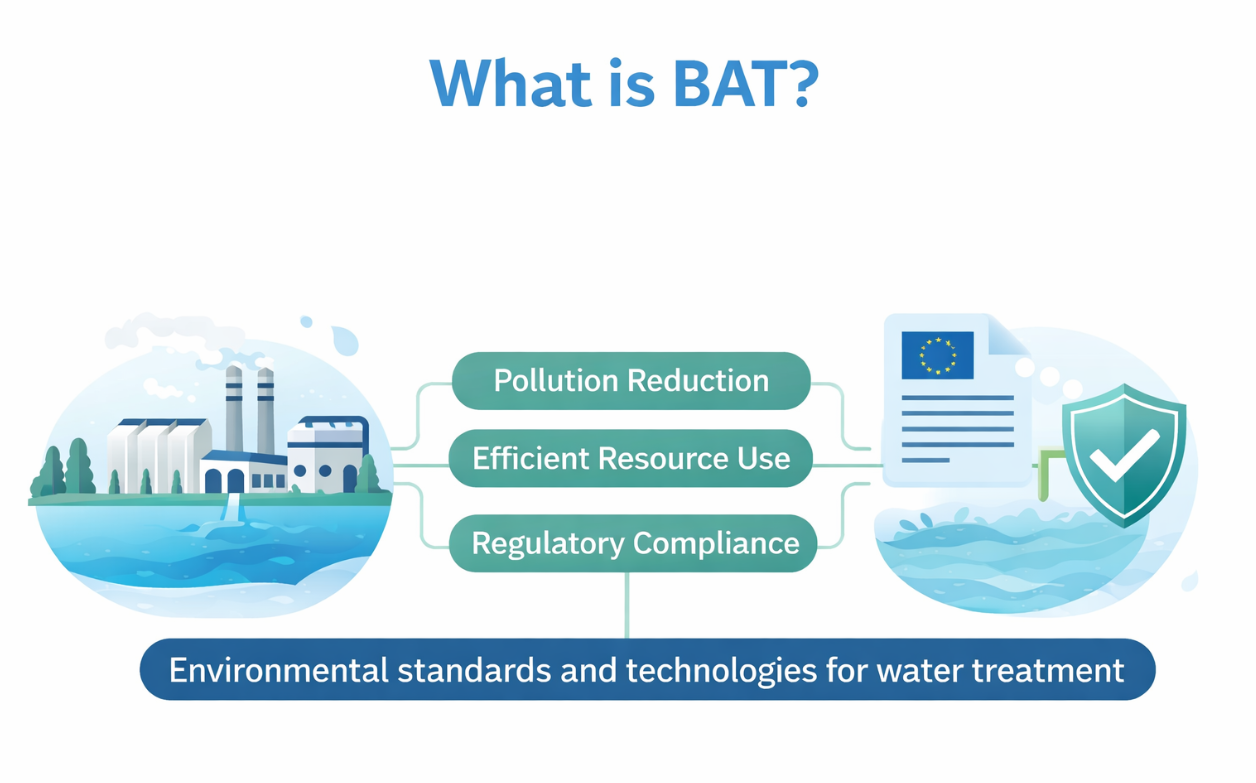
BAT (Best Available Techniques) refers to the most effective and advanced methods for preventing or minimising environmental impact while remaining economically and technically viable. In water treatment, BAT defines the standards and technologies required to achieve high levels of pollution reduction, efficient resource use and compliance with environmental regulations such as the EU Industrial Emissions Directive.
BAT and the EU Industrial Emissions Directive (IED)
BAT requirements are closely linked to the EU Industrial Emissions Directive (IED), which defines the regulatory framework for industrial pollution control. For industrial operators, this means wastewater treatment must be designed according to sector-specific BAT conclusions and aligned with BAT-AEL performance levels (BAT Associated Emission Levels), depending on the applicable industry and permit requirements.
BAT compliance is not defined by one universal discharge limit. Instead, BAT sets a framework of best available techniques and expected performance levels that vary by industrial sector and wastewater composition. In practice, meeting BAT requires a combination of proven treatment technologies, correct process design and reliable performance verification based on real wastewater behaviour.
Compliance roadmap
Your route to BAT compliance
1
Map requirements
Identify the BAT conclusions, BAT-AELs and local permit limits that apply to your site.
2
Characterise water
Sample and analyse each wastewater stream to understand its real behaviour.
3
Test & verify
Run electrocoagulation tests on your own water and document removal rates.
4
Design the process
Combine the right treatment steps for compliant discharge or reuse.
5
Deliver & document
Commission the plant and provide performance documentation for your permit.
Key parameters
Key parameters we treat
FjordFilter's treatment systems address the main parameters commonly associated with BAT discharge requirements. Our solutions can be designed both for compliant discharge and, when applicable, for reuse as technical water.
Suspended solids (TSS / particles)
Oil and grease (free and emulsified)
COD and BOD (organic load)
Dissolved organic substances
Dissolved inorganic compounds and salts
Nitrogen and phosphorus
Metals and site-specific contaminants
Phosphorus
up to99%
Suspended solids
up to98%
Heavy metals
up to98%
COD
up to79%
Up-to values. Results vary with water composition, so we always test on your own water before recommending a solution.
Overview of water treatment processes
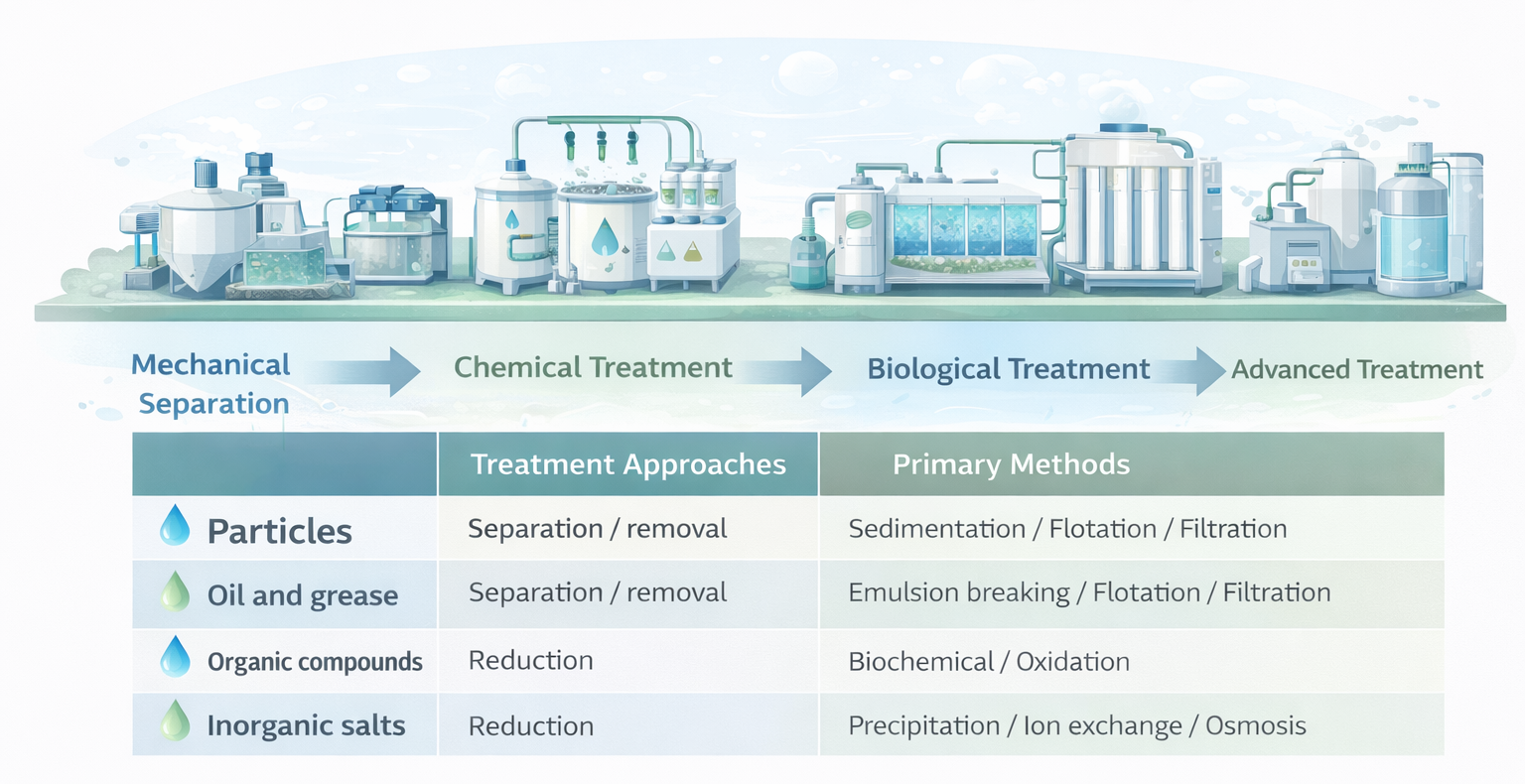
Industrial wastewater typically requires multiple treatment steps — from particles and oils to dissolved organic and inorganic fractions.
How FjordFilter achieves BAT performance
To reach BAT compliance, treatment must be adapted to each wastewater fraction. FjordFilter's process is chemical- and membrane-free. Our goal is to select the most effective and economically viable treatment line for each site.
Treatment step
Main purpose
Typical contaminants addressed
Sedimentation, filtration & flotation
Mechanical separation and solids removal
Particles, TSS, sludge, suspended matter
Emulsion handling & oil separation
Break and separate stable oil fractions
Oil & grease, emulsified oils, hydrocarbons
Aeration & stripping
Remove volatile compounds and improve water quality